How to choose a grid bot's range and step
You launched a grid, three days later the price left the range — and the bot sits idle, holding the coin it bought all the way down. The range is a grid bot's most important setting, and people get it wrong in both directions. Here is how to choose it from real volatility rather than a feeling that the market is ranging.
What the range does
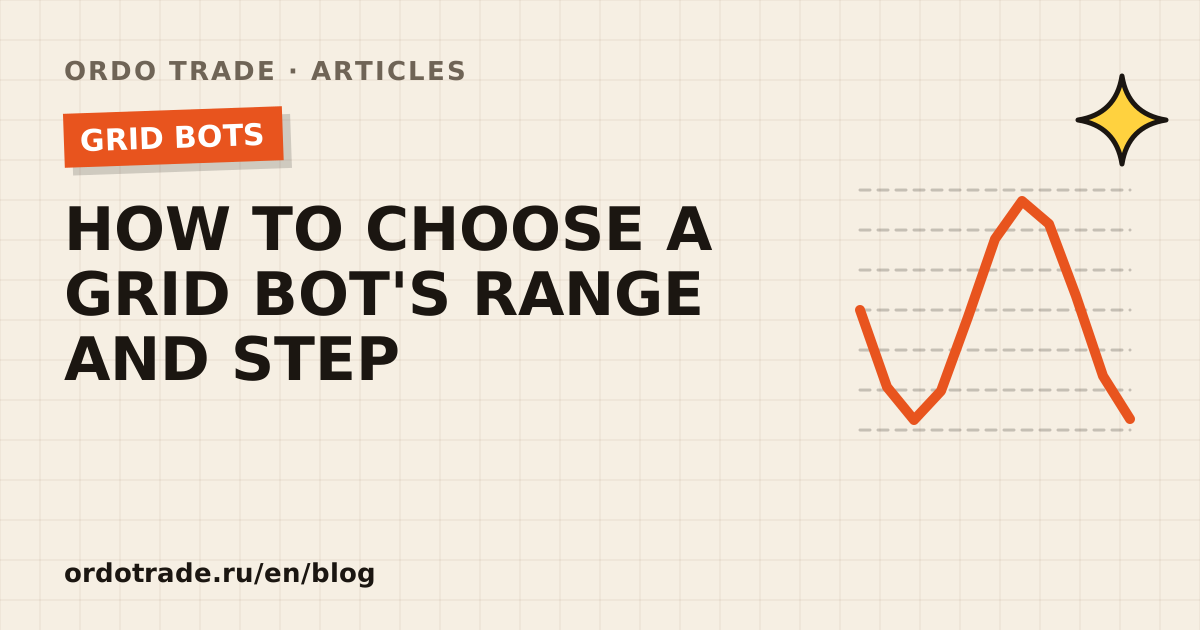
A grid buys at every level as the price falls and sells one level higher as it rises. While the price moves inside the range, the bot earns on the swings. As soon as the price crosses a boundary, the grid stops trading:
- downward — the bot holds the coin it bought all the way down and accumulates a loss on the position;
- upward — the bot has sold everything and sits in USDT, grid profit no longer grows.
The starting point is real volatility
Look not at “it seems it'll range” but at how the price actually moved over the period you're launching the bot for:
- Take the high and low over the last 14–30 days.
- Estimate the corridor width in percent: (high − low) ÷ low.
- Set the boundaries slightly wider than this corridor, not inside it.
If the coin moved within an 18% corridor over a month, an 8% range will almost certainly be broken.
Boundaries go wider than the real corridor of the last 14–30 days, not inside it.
Number of grids and step
Each level should earn more than its pair of trades costs. If the step is smaller than two fees plus the spread, the bot trades at nearly zero: many trades, little result. A practical guideline is a step of at least 0.5–1% on liquid pairs, more on less liquid ones.
A step smaller than two fees plus the spread means the bot works for the exchange.
The market matters more than the settings
- Grids like ranging markets. In a strong downtrend a spot grid turns into averaging down a falling coin.
- Liquidity. On a thin order book execution is worse and the spread wider — you need a bigger step.
- A leveraged futures grid adds liquidation risk and funding. Measure the distance to liquidation from the current price, not from the entry price.
When to revise the range
If the price has been outside the boundary for several days, the bot has two honest options: move the range around the current price (locking in the old grid's result) or stop it. “Wait for it to come back” is also a decision, but it should be made deliberately and with a review date.
Cheat sheet: before launching a grid
Six checks — before the money ends up in the bot.
- The 14–30 day corridor is measured(high − low) ÷ low, in percent.
- Boundaries wider than the corridorNot inside it.
- Step larger than two fees plus the spreadOn liquid pairs — a guideline of 0.5–1% and up.
- The market is ranging, not falling hardOtherwise a spot grid averages down a falling coin.
- Distance to liquidationFor a futures grid — from the current price.
- A review date is setWhat to do if the price stays outside the range for several days.
Testing on history
Before launching, it helps to run the settings on past data: how many days the price would have spent inside the range, how many trades the grid would have made, what the result would have been with the position and fees. Ordo Trade does this in the “Grid ideas” section: pairs with large volume and a profit on history, with a range and a check on past data. For bots already running, the journal shows whether the price is inside, how long the bot has been idle and what its real result is. This is analytics, not a promise of future results.
In short: frequently asked questions
How do I choose a range for a grid bot?
Rely on real volatility: take the high and low over 14–30 days and set the boundaries slightly wider than that corridor.
How many grids should I set?
Enough that the step between them clearly exceeds two fees plus the spread. On liquid pairs the guideline is a step of 0.5–1% and up.
What should I do if the price leaves the range?
Move the range around the current price, locking in the result, or stop the bot. Waiting for a return is also a decision, but with a review date set in advance.